The Vermont Center for Cardiovascular and Brain Health supports research by early-career scientists who are investigating the mysteries of the heart-brain connection. The researchers are sharing their findings at a symposium on June 15-16 at UVM’s Davis Center.
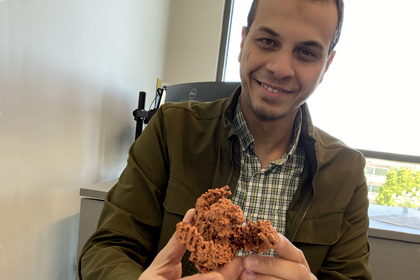
Osama Harraz holds a three-dimensional model of the Piezo1 protein, which senses frictional forces as blood moves through brain blood vessels.
The cardiovascular system and brain seem to work independently of each other, but growing evidence shows they are critically intertwined. Blood flowing through the body’s network of blood vessels nourishes and cleanses the brain, and factors that damage the heart or blood vessels can injure the brain and increase risks for developing dementia through Alzheimer’s and small vessel diseases of the brain.
In a state-of-the-art biomedical research center at the University of Vermont, a cadre of early career scientists is investigating the mysteries of the heart-brain connection. The researchers — experts in medicine, epidemiology, chemistry, pharmacology, molecular physiology, biophysics, rehabilitation and movement science, and more — shared their findings at the Vermont Center for Cardiovascular and Brain Health (VCCBH) symposium on June 15–16 at UVM’s Davis Center.
Established in 2020 with a $12 million, five-year National Institutes of Health Center of Biomedical Research Excellence (COBRE) grant, the projects cover a multitude of heart- and brain-health issues, including impacts of cardiovascular disease on brain motor function, brain blood flow, and cognitive decline. The VCCBH funding supports the work of researchers with labs in UVM's newly completed Firestone Medical Research Building and across the campus.
A unique aspect of the VCCBH is its emphasis on team-based, interdisciplinary mentorship from senior mentors and peer mentors. This structure also fosters a pipeline of 27 investigators who can replace project directors as they “graduate” from the center and establish their own, independent labs. Co-led by Mark Nelson, Ph.D., University Distinguished Professor and chair of pharmacology, and Mary Cushman, M.D., M.Sc., University Distinguished Professor and a vice chair of medicine, the goal of the center is to expand UVM’s research capacity and support early career investigators exploring cardiovascular and brain health.
“We support young investigators with pilot awards so that they grow the research mission with new grants, attract new students and postdoctoral fellows, and do cutting-edge research here in Vermont,” Nelson said. “We are developing the next generation of world-class researchers on major scientific and health issues. This is good for UVM, for the medical center, and for the community.”
The symposium provided a forum for the researchers to share their work with colleagues and to inspire promising young scientists. “It’s a showcase of the outstanding research being done at UVM on cardiovascular and brain health, with a focus on the next generation of researchers,” said Nelson. “Young people thinking about going into medicine, research, or the corporate world can see what’s going on here.”
Among the work presented was a project conducted by Osama Harraz, Ph.D., assistant professor of pharmacology, whose research focuses on the control of cerebral blood flow and vascular signaling. His presentation, titled “May the Force Be With You: Piezo1 and Cerebral Blood Flow Regulation,” will highlight the role of Piezo1, a protein that lives on the membranes of cells lining the blood vessels, in brain blood flow control. Named for the Greek word for “pressure,” Piezo1 is a receptor for frictional forces as the blood moves through the brain vasculature. Harraz collaborates with Ardem Patapoutian, Ph.D., a professor of neuroscience at Scripps Research and winner of the 2021 Nobel Prize in Medicine for the discovery of Piezo channel proteins. Harraz is interested in genetic mutations of Piezo1, especially among aging people of African descent.
“One in three African Americans has a mutation of Piezo1, and African Americans have the highest prevalence of hypertension and cardiovascular disease. It makes us wonder if there’s a connection and a therapeutic approach that we can take to prevent disease,” Harraz said.
Harraz recently received a new, $2.9 million grant from the National Heart, Lung, and Blood Institute to study Piezo1 in health and hypertension, which allows him to “graduate” from VCCBH and further establish his research program. He is currently recruiting junior investigators and lab personnel to join his team, which also studies Alzheimer’s disease with funding from the National Institute on Aging.
“I will run an independent lab at UVM – it’s such a great environment, and a collegial group of researchers,” said Harraz, adding that the VCCBH provides “a way for researchers with different backgrounds and interests to work together with a multidisciplinary approach, toward a common goal.”
Pilot grant recipients presenting their projects included Mansour Gergi, M.D., assistant professor of medicine and UVM Cancer Center member, who discussed cardiovascular care in cancer patients. The grant supports Gergi’s research evaluating risks for bleeding and clot formation in cancer patients with cardiovascular disease. “The funding from VCCBH provides me with protected time from clinical responsibilities, so I am able to conduct my research, evaluating whether a cancer diagnosis affects the decision of clinicians to continue blood thinners for cardiovascular indications,” Gergi said.
Pilot grant recipient, Matthew Caporizzo, Ph.D., assistant professor of molecular physiology and biophysics, presented his research investigating the molecular system that regulates diastolic function, the part of the heartbeat where the heart muscle relaxes and expands to fill with blood. Nearly all heart failure patients have some form of diastolic dysfunction, Caporizzo said.
“Our lab uses advanced techniques to characterize the stiffening of diseased hearts and determine the molecules responsible for stiffening in heart disease,” he said. “The VCCBH has been instrumental in helping me develop a new technique to relate changes in the heart's molecular structure to its relaxation and filling performance. … We are excited to test efficacy of new therapeutic approaches.”
Ten pipeline investigators presented their research in eight-minute “Flash Talks.” These included a project by Debora Kamin Mukaz, Ph.D., on “Residential Segregation and Risk of Hypertension in a Biracial Cohort.” Residential segregation refers to the geospatial manifestation of structural racism, or the separation of people into different living areas based on race or ethnicity. A postdoctoral fellow in the Department of Medicine, Mukaz explores links between residential segregation and unfavorable levels of biomarkers for inflammation and coagulation. These biomarkers may indicate hypertension, which is more likely among Black people than white people in the U.S. This research can inform changes that lead to better prevention measures, she said. “It’s a matter of justice. Ultimately, the goal is better policies to eliminate disparities in hypertension.”
The importance of diversity and inclusion in drug clinical trials was the topic of a keynote address by UVM alumnus Andra S. Stevenson, Ph.D.'01, M.P.H., a UVM undergraduate and doctoral alumnus and senior director of global medical affairs for Merck & Co., Inc.
“Lack of data from diverse populations may lead to overlooked differences. I want drugs I’m developing to work on everyone, but they may not. Research has found that some sex, race, and social determinants of health may contribute to outcomes,” Stevenson told the gathered crowd.
A science keynote address by David E. Clapham, M.D., Ph.D., group leader at the Howard Hughes Medical Institute Janelia Research Campus and professor of cardiovascular research and professor emeritus of neurobiology at Harvard Medical School, will highlight the function of smooth muscle, which regulates blood vessel tone and blood flow in the heart.
The symposium also included three poster sessions and a reception at the ECHO, Leahy Center for Lake Champlain in Burlington.
Learn more about the Vermont Center for Cardiovascular and Brain Health.
View Vermont media coverage of the VCCBH symposium on NBC5.