Promising young scientists from colleges across the UVM campus gathered recently to celebrate the broad training experience, varied investigations, and collaborative community of UVM’s postdoctoral scholars. Organized by the UVM Postdoctoral Association, the event provided a chance for the scholars to present their research and network with peers.
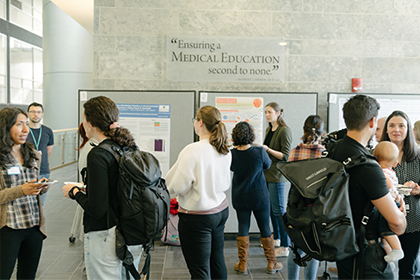
Postdoctoral fellows gathered in the Larner Medical Education Pavilion to share their research with colleagues, mentors, friends and family. (photo: Joshua Defibaugh)
Promising young scientists from colleges across the UVM campus gathered in the Larner Medical Education Pavilion recently to celebrate the broad training experience, varied investigations, and collaborative community of UVM’s postdoctoral scholars. Postdoctoral training provides an opportunity for scientists to further their research and professional skills under the mentorship of world-class faculty.
Sixteen postdocs, including eight from the Larner College of Medicine, presented their research to colleagues, mentors, friends, and family. Organized by the UVM Postdoctoral Association and held on the final day of UVM’s second annual Research Week April 17-21, the Postdoctoral Research Showcase provided a chance for scholars to network with postdoctoral peers and practice their presentation skills. Read on for some highlights of their scholarly work.
Rebekah Honce, Ph.D.
Host and Viral Determinants of Arenaviruses Pathogenesis
How do certain viruses, like arenaviruses or ebolaviruses, infect wild rodents without making them sick, but in humans cause flu-like symptoms, hemorrhagic fevers, encephalitis, and even death? Research by Rebekah Honce, Ph.D., investigates this mystery. Honce works with Jason Botten, Ph.D., professor of medicine, to explore how differences in viral populations in rodents and humans can dictate the ability of a virus to cause disease. “We’re trying to model how certain components of this viral population may be allowing mice to be perfectly fine,” Honce said. “One of the dominant hypotheses is that, in mice, the virus exploits the host cell to make interfering particles that prevent severe pathogenesis and protect the host, so as not to harm the rodent.” In the long term, this research may lead to an ability to replicate interfering particles to create vaccines that prevent disease in humans.
Debora Kamin Mukaz, Ph.D.
Residential Segregation and Hypertension Risk in Black and White Americans
Black people in the U.S. are more likely than white people to suffer from hypertension, a risk factor for stroke and other cardiovascular diseases. Evidence points to residential segregation as the root cause of this health disparity. Residential segregation refers to the geospatial manifestation of structural racism, which results in the separation of people into different living areas based on race or ethnicity. This separation takes away resources and opportunities from communities. In the U.S., residential segregation has resulted in a majority of Black people living in under-resourced areas compared to areas with a majority of white people. Research by Deborah Kamin Mukaz, Ph.D., explores links between residential segregation and the development of hypertension, and links between residential segregation and unfavorable levels of biomarkers of inflammation and coagulation. This research can inform changes that lead to better prevention measures, Mukaz said. “It’s a matter of justice. Ultimately, the goal is better policies to eliminate disparities in hypertension, because hypertension is very dangerous.” Mukaz’s postdoctoral advisor is Mary Cushman, M.D., M.S., professor of medicine.
Deena Snoke, Ph.D.
Early Adipose Tissue Wasting in a Novel Model of Lung Cancer Cachexia
One of the early symptoms of lung cancer is cachexia, a complicated metabolic syndrome characterized by muscle wasting and body fat loss. As cancer progresses, cachexia becomes more difficult to control, and patients become less responsive to treatment. Deena Snoke, Ph.D., investigates early body fat wasting in a novel model of lung cancer cachexia using lung cells from mice. The objective of this research is to develop and characterize a model of lung cancer cachexia that better aligns with the clinical syndrome. “We want to identify these early events so that we can better target the disease before the wasting is already occurring,” Snoke said. Snoke’s faculty mentor is Michael Toth, Ph.D., associate professor of medicine and vice chair for research in the department of medicine.
Dhemerson Souza de Lima, Ph.D.
The role of ER-phagy pathway in influenza virus infection
Influenza, a major respiratory pathogen that causes severe respiratory disease in susceptible populations, has developed resistance to available drugs. Research by Dhemerson Souza de Lima, Ph.D., explores the intra-cellular pathways that influenza uses, with special focus on endoplasmic reticulum (ER) pathways. ERs are cell organelles that make proteins the cell needs. Souza de Lima’s work examines whether influenza utilizes ER-phagy, a specialized pathway to recycle a damaged ER. Deregulation in ER-phagy is reported with infectious agents such as Ebola and Zika, but the role of ER-phagy in influenza propagation is unknown. Souza de Lima works with Vikas Anathy, Ph.D., associate professor of pathology and laboratory medicine.
Colleen Kelly, Ph.D.
Mechanisms of Cardiac Myosin Replacement
Myosin, the most abundant protein in the heart, participates in the repetitive contractions that result in the continual beating of the heart. Colleen Kelly, Ph.D., works with Michael Previs, Ph.D., assistant professor of molecular physiology and biophysics, to investigate the mechanisms that govern the replacement of cardiac myosin. A recent study from the Previs lab demonstrated that individual myosins are randomly replaced in adult mouse hearts. At the postdoctoral research presentation, Kelly discussed new findings about how myosin is randomly exchanged into the contractile structures of the heart. These findings include the rate of replacement, the regions to which myosin exchange is confined, and the conformation myosin adopts in the soluble state. “We think that the rapid incorporation and release of myosin molecules into the contractile structures of the heart supports protein replacement while also maintaining the structural integrity that is essential to support contractility,” Kelley said.
Learn more about the UVM Postdoctoral Association.