In late March, Professor of Surgery Gary An, M.D., and Assistant Professor of Surgery R. Chase Cockrell, Ph.D., joined an international coalition of virologists, pharmacologists, and mathematicians to help build a computer model of SARS-CoV-2 tissue that simulates the changing behavior of the virus once it enters the body.
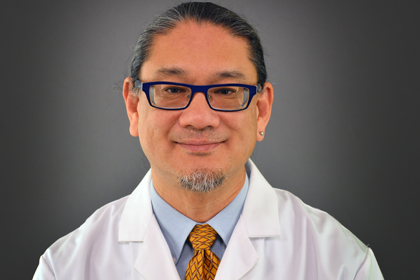
Gary An, M.D., Professor of Surgery
Bright blue and white lights pulse across the grid of black squares like fireflies. While reminiscent of a summer night’s sky, the video images are actually a computer model of pulmonary inflammation that University of Vermont Professor of Surgery Gary An, M.D., retooled to depict a COVID-19 cytokine storm and posted on Twitter, where scientists worldwide have been sharing ideas to identify potential treatments for the virus, which challenges standard interventions.
An has nearly 20 years of experience in creating models of sepsis, which like COVID-19, invokes a hyper-inflammatory response called a cytokine storm. In late March, he and Assistant Professor of Surgery and theoretical physicist R. Chase Cockrell, Ph.D., joined an international coalition of virologists, pharmacologists, and mathematicians led by Indiana University’s Paul Macklin, Ph.D., to help build a SARS-CoV-2 tissue simulator that models the changing behavior of the virus once it enters the body. An has collaborated with Macklin for several years.
The coalition members modeled the underlying mechanisms of COVID-19, “from viral invasion all the way through manifestation of disease,” An said. “The scientific community pretty rapidly identified the various phases of the viral life cycle and found potential drugs that theoretically targeted those various areas,” explained An.
The hurdle, however, was a lack of time to test potential treatments using a traditional approach. Conducting “in silico” trials – using computer models that model the mechanisms of the viral infection – allows scientists to explore how those drugs might work and can also provide insight about treatments that are either too toxic or not effective due to the complexity of the processes involved in COVID-19.
Over the past three months, the researchers have been running simulations of different scenarios, identifying weak spots in viral replication and spread of infection, while also testing proposed therapies for controlling the immune response to avoid adverse outcomes, like unexpected side effects.
Among the many modules in use by coalition members is An’s model of the cellular and molecular interactions of the cellular immune response to viral infection. Called the Cellular Immunity Agent-based Model (CIABM), the model was initially developed as part of a UVM Translational Global Infectious Disease Research project to study dengue vaccine development in collaboration with Associate Professor of Medicine Jason Botten, Ph.D., and Assistant Professor of Microbiology and Molecular Genetics Sean Diehl, Ph.D. The COVID-19 version, said An, “is intended to be a general platform for drug and vaccine development. We are modeling the initial aspects of the systemic response to infection.”
According to An, the UVM group has also been providing expertise on how to use and analyze these complex multi-component models using machine learning and artificial intelligence on supercomputing resources.
”The development of these types of models is a complex process that requires constantly reviewing the rapidly-evolving literature on the potential mechanisms of how the SARS-CoV-2 virus invades human tissue and causes disease, and turning that knowledge into computer code,” said An.
A May 2020 preprint in BioRxiv, which reported on an earlier phase of the SARS-Cov-2 tissue simulator, highlighted additional features of the immune response and tissue damage, bringing it closer to interfacing with the models being developed at UVM. The next update of the preprint (the third version) is expected to post in early July.
“At UVM, the CIABM has undergone further validation by matching its behavior to existing influenza data, a step which uses a much better understood disease process to confirm the underlying structure of the model,” An said, adding that plans are underway to start simulating COVID-19 and various types of potential interventions.
The SARS-CoV-2 tissue simulator is an open source project, available to the large community of researchers working on COVID-19 projects worldwide on the project website.
“The model we are building is a community resource; it is fully open source and available to all for their research projects,” Macklin said in an April 10 press release. “This allows the maximum benefit of the coalition’s collaboration, and it also encourages the community to share best results, parameter estimates, and data. This way, we can all work together and pool our expertise and experience to much more rapidly attack COVID-19. We also know that SARS-CoV-2 will not be the last novel pathogen or pandemic we will face. After we build this coalition and community resource, it will be available for the next health crisis. We won’t have to do this rapid crash prototyping project but can instead move straight to progress.”
In addition to Indiana University and UVM, institutions participating in this project include the University of Montreal, the CHU Sainte-Justine Research Centre in Montreal, Pepperdine University, Oklahoma State University, George Mason University, the University of Tennessee, the University of Chicago, and the Argonne National Laboratory.
(Portions of this article were adapted from an April 10, 2020 news release produced by Ken Bikoff of Indiana University Bloomington.)