Teaching Academy Newsletter

Announcements

WRITER’S WORKSHOP MEETS AT A NEW TIME!

The monthly Writer’s Workshop now meets on the first Monday of the month at noon. The next meeting is Monday, November 6 at noon in The Teaching Academy Resource Room 130F. Bring scholarly work on education topics in any stage of development – manuscripts, conference proposals, research proposals, etc. Submit to Randi-Lynn.Crowther@med.uvm.edu

REGISTRATION IS OPEN

AAMC Medical Education Research Certificate (MERC) Workshop “Formulating Research Questions and Designing Studies,” Judy A. Shea, PhD, University of Pennsylvania School of Medicine
Friday, December 8; 1:15 – 4:15 PM; MedEd 300 
Please register by November 1. Use this link to complete a registration form.
A minimum enrollment of 8 participants is required, the maximum enrollment is 25. 
For more information about the MERC program visit: https://www.aamc.org/members/gea/merc/

CALL FOR EDUCATION TOPIC POSTERS - Snow Season Education Retreat, January 11 – 12, 2018

This is an open invitation to submit a poster about your educational work, innovation, or research. We are seeking poster submissions (whether current or past work) for the 2018 Snow Season Education Retreat. This will be an opportunity for UVM LCOM educators to share ideas and to collaborate across departments. We are particularly interested in work related to the education of professionals across the continuum of learners. We will consider posters you have presented at previous venues, other than Teaching Academy events. 

The poster session is Thursday evening, January 11, with additional poster viewing time on Friday morning. The deadline for poster abstract submission is November 15, 2017. To submit an abstract, please use the poster abstract submission form, and submit to teaching.academy@med.uvm.edu.  In addition, authors may elect to receive peer review and feedback on their poster(s).

SAVE THE DATE!  

Registration for the Snow Season Education Retreat will be announced soon! Please save the date for January 11 – 12, 2018. All events are at the Sheraton Hotel and Conference Center. Thursday evening includes, reception, poster session, and dinner with induction of new Teaching Academy members and recognition of teaching and education awards. Friday is an all-day education retreat which will feature workshops, networking, and keynote speaker, Susan Skochelak, MD, MPH, Group Vice President, Medical Education, American Medical Association. This event is open to all faculty and CME credit will be available. 


Questions about The Teaching Academy?
Please contact Teaching Academy Coordinator, Randi-Lynn.Crowther@med.uvm.edu 

Research News

Rincon and Champagne's Discovery Could Help Boost Flu Vaccine Response

May 24, 2016 by Carolyn Shapiro

A relatively unknown molecule that regulates metabolism could be the key to boosting an individual’s immunity to the flu – and potentially other viruses – according to research reported today in the journal Immunity.
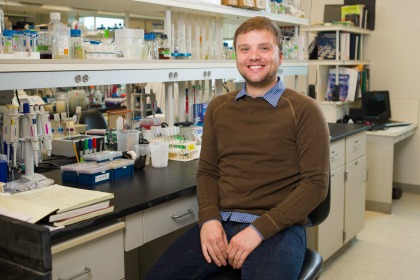
Devin Champagne, a graduate student working in the lab of Professor of Medicine Mercedes Rincon, Ph.D. (Photo: COM Design & Photography)

A relatively unknown molecule that regulates metabolism could be the key to boosting an individual’s immunity to the flu – and potentially other viruses – according to research reported today in the journal Immunity.

The study, led by University of Vermont (UVM) College of Medicine doctoral student Devin Champagne and Mercedes Rincon, Ph.D., a professor of medicine and an immunobiologist, discovered that a protein called methylation controlled J – or MCJ – can be altered to boost the immune system’s response to the flu.

Metabolism is a crucial function that helps keep cells alive. It plays a role in a range of bodily processes – from the conversion of food into energy to the ability to fight off infection. MCJ is the part of the cell that produces energy and enables metabolism.

“It’s the engine of the cell,” says Rincon, who adds that previously, researchers assumed that the mitochondria were constantly active. She and Champagne discovered that MCJ acts as a braking system in the mitochondria, slowing these organelles down. Without MCJ, the mitochondria are hyperactive.

In the T cells of the body’s immune system, specifically the CD8 T cells that fight viruses and infections, metabolism helps ensure that those bug-fighting cells remain active and don’t tire out. When a virus attacks, CD8 cells detect and kill it while leaving the healthy cells intact.

MCJ controls the metabolism of the CD8 cells. It prevents the mitochondria from generating too much energy and making the CD8 cells so overactive that they kill healthy cells.

A vaccine, such as a flu shot, trains the CD8 cells to identify that virus and destroy it. With a good vaccine, the CD8 cells will “remember” and protect against that virus for a long time.

“The metabolism of immune cells is very important,” explains Rincon. “It is critical to determining effective protection against infection, but also if vaccines will work,” she says.

For their study, Champagne and Rincon generated mutant mice without MCJ and infected both normal mice and mice lacking MCJ with flu virus – imitating a vaccine, so the animals’ CD8 cells would learn to recognize the bug. After four weeks, they took the CD8 cells from the infected mice and injected those cells into other mice. One group received normal CD8 cells; the other group got cells without MCJ.

The researchers gave those new mice very high doses of the same flu virus. The mice with normal CD8 cells all died from the virus, indicating that the “educated” CD8 cells did poorly in protection. In contrast, the mice injected with MCJ-deficient CD8 cells had proper protection and all survived.

Champagne and Rincon concluded that with normal MCJ levels, CD8 cells are not as efficient in fighting virus because their mitochondrial metabolism is not strong enough, so the removal of MCJ (the “mitochondrial brake”) can improve the CD8 cells protection capability – and thus the efficacy of a vaccine.

“Nothing has been shown to do what this protein does,” says Rincon. “Suppressing MCJ will enhance your immune response and protection from an influenza virus and, most likely, protection from other threatening viruses.”

The researchers are now testing potential therapies for fatty liver disease by eliminating MCJ in liver cells. That action speeds up the metabolism process of breaking down lipids and converting fat into energy, thus reducing the presence of the disease, which affects 15 to 20 percent of humans, Rincon says.

Co-authors on the Immunity study include UVM colleagues Tina Thornton, Ph.D., research associate; Karen Fortner, Ph.D., research assistant professor; Rui Yang, predoctoral student; and former UVM doctoral student Ketki Hatle, Ph.D., as well as research colleagues in Spain, Korea, Colorado and Connecticut.

This research was supported by a National Institutes of Health Grant #1R21AI110016-01A1.

October 2017

Upcoming Events
Research Consultation Drop-In Hours

Friday, October 13, 9:00 – 11:00 AM; and Tuesday, October 24, 1:00 – 3:00 PM; Larner Learning Commons, Teaching Academy, Room 130

The Teaching Academy hosts drop-in hours for research consultation, with Alison Howe, M.S., Director of Education Program Outcome Analysis, and Leigh Ann Holterman, M.A., Director of Curricular Evaluation and Assessment. Drop in hours occur the second Friday of the month from 9 – 11 am, and the fourth Tuesday of the month from 1 – 3 pm. First come, first served.

Mentoring Groups

Monday, October 16, 2017, 4:15 – 5:15 PM; HSRF 200
Leadership, led by Lewis First, MD, and Bridget Marroquin, MD
Closed group.

Monday, October 23, 2017, 12:00 – 1:00 PM; MedEd 204
RPT, led by Charles Irvin, PhD, and Sarah McCarthy, PhD
This month’s topic will be “Deciding when you are ready for promotion”.
Open to all faculty.

Tuesday, October 24, 5:00 – 6:00 PM; HSRF 200
Teaching for Active Learning, led by Stephen Everse, PhD, and Charlotte Reback, MD
This month’s topic will focus on TBL.
Open to all, no RSVP required.

Thursday, October 26, 12 – 1 PM; MedEd 203
Educational Scholarship, led by Katie Huggett, PhD, Cate Nicholas, MS, PA, EdD, and Elise Everett, MD
This month’s topic will be Program Evaluation as Research, and there will be time for open discussion and consultation.
Please RSVP for lunch: teaching.academy@med.uvm.edu

Medical Education Grand Rounds

Friday, October 27, 2017, 12:00 – 1:00 PM; Reardon Classroom, MedEd 300
“Identifying Best Instructional Practices: Promoting Self-Reflection for Enhancing Efficient and Effective Learning,” Norma S. Saks, EdD, Assistant Dean for Educational Programs and Director, Cognitive Skills Program, Professor, Department of Psychiatry; Rutgers Robert Wood Johnson Medical School
Please RSVP for lunch: teaching.academy@med.uvm.edu