Teaching Academy Newsletter

Announcements

 
Frymoyer Scholars Program 2020 Call for Proposals


The Frymoyer Scholars Program supports physicians and nurses who are actively engaged in teaching University of Vermont medical and nursing students and who embody the best qualities of the clinician teacher. We hope you will take advantage of this opportunity by submitting a proposal. Applications for 2020 are due by March 16, 2020. The program has funded 52 projects over the past 19 years. The results accomplished by Frymoyer Scholars have enhanced the learning experience of our students and improved patient care. Click here for the 2020 Frymoyer Scholars Program Call for Proposals Frymoyer Scholars Program on the Teaching Academy website: http://www.med.uvm.edu/teachingacademy/fellowshipsandgrants

 
CONGRATULATIONS!

Leigh Ann Holterman, PhD, Director of Curricular Evaluation and Assessment, has been appointed to the UVM President’s Commission for Inclusive Excellence. The President's Commission for Inclusive Excellence (PCIE) is an institutional advisory board at the University of Vermont whose primary mission is to advance the strategic diversity and inclusion goals of the university. Read more here: https://www.uvm.edu/president/presidents-commission-inclusive-excellence

Elise Everett, M.D., M.S., associate professor of obstetrics, gynecology and reproductive sciences, has been appointed level director of the clinical curriculum, reporting to Tania Bertsch, M.D., associate dean for clinical education. She will assist in articulating the mission, vision, and values of the clerkship and required acting internships curriculum; stimulate collaborative endeavors to improve all academic programs; promote educational innovation and research; seek and support external funding opportunities; and participate actively in continuous educational quality improvement.

Julie Lahiri, M.D., associate professor of surgery, has been appointed by the Society for Vascular Surgery Executive Board as a member of the new Equity, Diversity, and Inclusion Task Force. The task force researches “inequities related to gender, race, ethnicity, age, and sexual orientation and develop strategies to reduce identified inequities” within the vascular surgery specialty.

Jesse Moore, M.D., director of active learning and associate professor of surgery, is serving as chair of the Surgery Item Writing and Review Task Force for the National Board of Medical Examiners. The committee met earlier this fall to review questions and align the surgery subject exam with the American College of Surgeons/Association of Surgical Education Medical Student Core Curriculum.


SAVE THE DATE: Society of General Internal Medicine (SGIM) New England Regional Meeting

Teaching Academy Member Halle G. Sobel, MD is New England Regional President for SGIM and their meeting will be held in Burlington, VT on Saturday, October 10, 2020. Agenda and registration coming soon. For more information, visit: https://www.sgim.org/meetings/regional-meetings/new-england#

 
Upcoming Webinars

AAMC: Publishing in Academic Medicine: Meet the Editor and Tips for Success - February 13; 12:30pm

https://aamc.elevate.commpartners.com/products/publishing-in-academic-medicine-meet-the-editor-and-tips-for-success-february-13

AMA: The AMA and Medical Education: How did we get here and where are we going? – February 17; 4:00pm

https://cc.readytalk.com/registration/#/?meeting=yc0qm2dlnza&campaign=sa3q4ekjnsze 

AAMC: A Roadmap for Publishing Health Professions Education Scholarship - March 9; 1:00pm

https://aamc.elevate.commpartners.com/products/a-roadmap-for-publishing-health-professions-education-scholarship-march-9

 
SAVE THE DATES: IAMSE Spring 2020 Webcast Audio Seminar Series

Join us every Thursday in March and the first Thursday in April for the IAMSE Spring 2020 Webcast Audio Seminar Series. The theme for the Spring series is "Evolution and Revolution in Medical Education: Health Systems Sciences" where they will feature several speakers from across the US. All sessions take place Thursdays from 12:00 pm – 1:00 pm, Med Ed 204. To view remotely, contact teaching.academy@med.uvm.edu for login details. For schedule and speakers click here.


NEGEA 2020 Annual Conference

"Adaptive Education: Teaching for Learning and the Public Good" 

new NEGEA logo

Thursday, April 30-Saturday, May 2, 2020
The Robert Larner MD College of Medicine will host the 2020 NEGEA Annual Conference. The NEGEA is one of four regional groups of the AAMC’s Group on Educational Affairs (GEA). Its purpose is to promote excellence in the education of medical students, residents and physicians through the professional development of medical educators. Regional meetings provide a forum for exchanging ideas, learning new strategies and developing plans that may facilitate your own work and the implementation of the NEGEA’s mission.

See information about a new NEGEA Health Humanities Special Interest Group (SIG) Presents a Preconference Symposium: The Health Humanities as a Teaching and Learning Strategy 

Registration opening next week!


Questions about The Teaching Academy?
Please contact:teaching.academy@med.uvm.edu

New Publications from Teaching Academy Members


The Mindful Manager: Validation of a Rounding Leadership Instrument for Residents.
Ricotta DN, Ranchoff BL, Beltran CP, Hale AJ, Freed JA, Huang GC. The Mindful Manager: Validation of a Rounding Leadership Instrument for Residents. Journal of General Internal Medicine. 2020 Jan 2:1-6. DOI: 10.1007/s11606-019-05348-1

Development and Validation of the ACP-CAT for Assessing the Quality of Advance Care Planning Communication
Yuen JK, Kelley AS, Gelfman LP, Lindenberger EE, Smith CB, Arnold RM, Calton B, Schell J, Berns SH. Development and Validation of the ACP-CAT for Assessing the Quality of Advance Care Planning Communication. Journal of pain and symptom management. 2020 Jan 1. DOI: 10.1016/j.jpainsymman.2019.09.001


New Publications to Note


Beyond the default colon: Effective use of quotes in qualitative research
Lingard L. Beyond the default colon: Effective use of quotes in qualitative research. Perspective on Medical Education. Dec 2019. https://doi.org/10.1007/s40037-019-00550-7

Tools for discussing identity and privilege among medical students, trainees, and faculty
Chow CJ, Case GA, Matias CE. Tools for discussing identity and privilege among medical students, trainees, and faculty. MedEdPORTAL. 2019;15:10864. https://doi.org/10.15766/mep_2374-8265.10864

“Kids these days”: Reconsidering our conversations about Millennial learners
Regehr G. “Kids these days”: Reconsidering our conversations about Millennial learners. Medical Education. 17 Dec 2019. https://doi.org/10.1111/medu.14002

Generational ‘othering’: The myth of the Millennial learner
Jauregui J, Watsjold B, Welsh L, Ilgen J, Robins L. Generational ‘othering’: The myth of the Millennial learner. Medical Education. 13 Sep2019. https://doi.org/10.1111/medu.13795


Regional/National Call for Proposals 

Ferenc Gyorgyey Research Travel Grant - Yale Medical Library

The Ferenc Gyorgyey Research Travel Grant is available to historians, medical practitioners, and other researchers outside of Yale who wish to use the Historical collections of the Harvey Cushing/John Hay Whitney Medical Library. In any given year the award is up to $1,500 for one week of research. Funds may be used for transportation, housing, food, and photographic reproductions. The award is limited to residents of the United States and Canada. For more information, please visit: https://library.medicine.yale.edu/historical/research/grant The deadline is May 1st, 2020. A committee will review applications and grant recipients will be notified in early June. Please apply through Yale University Grants & Fellowships website. For more information contact: Melissa Grafe, Ph.D.E-mail: melissa.grafe@yale.edu


Teaching Academy in the News

Director of Student Well-Being Rosen Published in The Snowboarders Journal

January 21, 2020 by Republished with permission from The Snowboarders Journal

Lee Rosen, Ph.D., assistant professor psychiatry and director of student well-being, recently published an essay, titled “Tumbling into Mindfulness–A Novice at Age 50,” in the November 2019 issue of The Snowboarder’s Journal. His essay explores how learning to snowboard as an adult forced him to practice the “growth mindset” he teaches to students and patients.
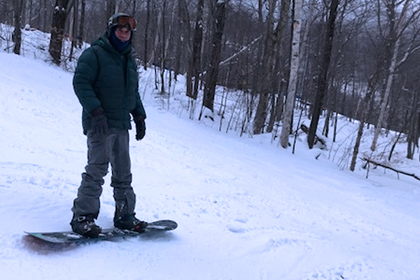
Director of Student Well-Being at the UVM Larner College of Medicine Lee Rosen, Ph.D., snowboards at Bolton Valley Ski Resort in Vermont

Lee Rosen, Ph.D., assistant professor psychiatry and director of student well-being, recently published an essay, titled “Tumbling into Mindfulness–A Novice at Age 50,” in the November 2019 issue of The Snowboarder’s Journal. His essay explores how learning to snowboard as an adult forced him to practice the “growth mindset” he teaches to students and patients. “In my teaching and clinical practice, I often ask people to embrace being uncomfortable . . . My turn. I let go of my fragile ego and notions of self-worth. Liberation through humility.”

Rosen's essay, which was originally run in the publication's Issue 17.2, is re-published below with permission from The Snowboarder's Journal.

TUMBLING INTO MINDFULNESS
A Novice at Age 50

IN THE WINTER of my 50th year, I had the clever idea that I’d learn to snowboard. My 10 year old, Eli, was in his second year of riding and taking to it with tenacity. As I monitored his progress, the usual paternal pride grew into genuine admiration. Seeing him navigate the process of falling, getting up, falling and then finally staying up, I realized I was witnessing the alleged “growth mindset” in action.

In Carol Dweck’s book, Mindset: The New Psychology of Success, the eminent social psychologist makes the claim that successful, fulfilled people’s growth and skill come from effort and practice rather than innate talent. The growth mindset entails flinging oneself at difficult, uncomfortable endeavors because that’s where we attain personal and neurological expansion. This was manifest in my kid, who would return home from the hill battered but buoyant. By the end of that first winter, Eli could make it down the greens and had embraced the snowboarder identity—the lingo, the swagger, the works. “Was out shredding today,” read his Saturday evening text to friends.

We went to Cochran’s Ski Area, a local Vermont hill owned by the Cochran family of Olympic skiing fame and equipped with two rope tows and a T-bar where I followed my son around on skis. I’ve skied since I was young, and while watching Eli was vicarious fun, the skiing itself wasn’t particularly exhilarating. “I’ll learn to snowboard,” I thought. “How hard could it be?” Pride, evidently, comes before the fall.

Eli soon graduated to riding at Bolton Valley, another cozy Vermont mountain, this one with chairlifts. I rented some gear, full of optimism. The boots were shockingly comfortable. Why would anybody ski? But oh, that first morning snowboarding, my neck still aches when I think about it. Grudgingly detaching myself from the lift, it was never a question of whether I’d fall but rather how many innocents I’d take down with me. There wasn’t much cover that winter, the trail was packed thin with a rock-hard layer of ice underneath. I was back on skis after two runs. Total defeat.

Yet I couldn’t shake the desire to snowboard. I felt like snowboarders were my people, that I was just a sort of problematic member of the tribe. I’m not particularly hip or edgy. By day, I’m a Ph.D. in clinical psychology. At the University of Vermont, I teach doctoral students how to treat people with anxiety and medical students how to reflect and communicate. As occupations go, it’s a bit nerdy. I’ve never been a cool kid. But I felt like a snowboarder.

Fast-forward to the following winter, January 2016, my month of destiny. My son and I returned to Cochran’s. Eli made his way to the T-bar while I committed to the Mighty Mite rope tow, where toddlers around here gain their snow legs. Relieved from the chairlift dismount, I was nonetheless fully capable of falling on the rope tow. Three-year-olds zipped by, staring at me with curiosity.

In the academic world where I work, competence is the coin of the realm. By age 50, you’re supposed to have your act together. Though at Cochran’s I was, without exception, the most incompetent person in the entire place. Sprawled out on the snow, I peeked around to see if anyone had witnessed my latest wreck. I felt ridiculous. But what could I do? I wasn’t leaving until I learned how to do this. Gradually, I gave myself over to humility. This is what it means to be a beginner, to be a learner. In my teaching and clinical practice, I often ask people to embrace being uncomfortable. My turn. I let go of my fragile ego and notions of self-worth. Liberation through humility.

Gradually, I got the feeling for sliding on my toe-edge. Feeling sheepishly triumphant, I managed to get down the hill without falling constantly. Eli cruised by at one point, “Dad, you’re going backward!” he yelled. I was so focused on staying upright I couldn’t respond. Backward, forward, I could barely tell. All I knew was that I was
upright and moving.

Awkwardly maneuvering down the Mighty Mite, I became fully engaged in the present moment—complete absorption. I could think of nothing but where my body was in relation to the slope. If my attention drifted from present-moment awareness, I fell. If I maintained even-flowing focus, I could stay on my feet. I spend a lot of time teaching people how to be mindful, to cultivate awareness of current experience with acceptance, and there it was. Snowboarding demanded it of me. My near-constant state of fretting came to a complete halt as I surrendered to the requirements of the ride.

I left Cochran’s exhausted, pummeled and jubilant—refreshed in a way I haven’t felt in a long time. I couldn’t wait to go back. In the meantime, I talked to my students with a renewed passion regarding a beginner’s mind, for atop the Mighty Mite I discovered the joys of being a novice at age 50.

A PDF of the full essay can be accessed here and you can check out more essays at The Snowboarder's Journal here. Read full story

February 2020

Upcoming Events

Medical Education Grand Rounds

Friday, February 14; 12:00 - 1:00 PM; Med Ed 300 (Reardon Classroom)
"Putting Theory into Practice: A Method for Generating Useful Pre-class Materials to Enhance Student Engagement"
Andrew Binks, PHD Carilion School of Medicine, Virginia Tech. Lunch is provided; please RSVP to teaching.academy@med.uvm.edu

Educational Scholarship Mentoring Group 

Thursday, February 27; 12:00 - 1:00 PM, Dana Medical Library Classroom
"How to Select a Research Method" with Katie Huggett, PhD and Cate Nicholas, MS, PA, EdD
The theme this year is “How to…?” and each session will tackle a question we hear from faculty. These are interactive sessions with ample opportunity for questions, discussion, and networking. Attend when your schedule permits – you may attend just one or all sessions. Sessions are open to all LCOM faculty.Click here for details.

IAMSE Spring Webinar Series

Thursday, March 5; 12:00 - 1:00 PM; MedEd 204
IAMSE Spring Webcast Audio Seminar Series: Evolution and Revolution in Medical Education: Health Systems Sciences "The Third Pillar of Medical Education: Health Systems Science" with Ami DeWaters, MD and Jed Gonzalo, MD
Drop in event; email teaching.academy@med.uvm.edu for details.