Sometimes new insight comes from simply crunching the numbers. In Robin Leopold’s case, lots of numbers. For his fourth-year scholarly project, the soon-to-be graduate of the UVM Larner College of Medicine decided to dig into the data regarding the number of women who receive annual mammograms despite a diagnosis of an advanced non-breast malignancy.
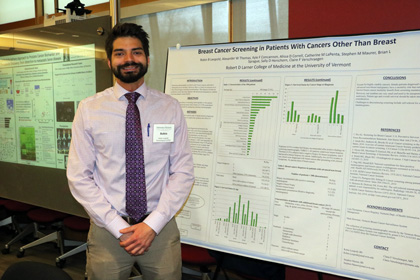
Robin Leopold '17 presents his scholarly project at the UVM Cancer Center mini-symposium (Photo: LCOM Creative Services)
Sometimes new insight comes from simply crunching the numbers. In Robin Leopold’s case, lots of numbers. For his fourth-year scholarly project, the soon-to-be graduate of the UVM Larner College of Medicine decided to dig into the data regarding the number of women who receive annual mammograms despite a diagnosis of an advanced non-breast malignancy. With a team of five classmate volunteers, he reviewed 400 charts from the Vermont Cancer Registry for patients who had a screening mammogram and stage II or greater non-breast cancer. His question: Did the mammogram have clinical benefit for patients faced with an advanced cancer? Several measures indicate it didn’t. None of the women with a stage II or greater cancer, who were then diagnosed with breast cancer, died of the breast cancer. And 72 percent of patients with a positive mammogram underwent biopsy that showed benign disease, contributing to stress but not an improved outcome. Guidelines for when to discontinue mammography screening lack consensus, which means that health care providers may need to have some difficult conversations with women facing cancer with a less than 50 percent chance of cure, a point the study makes. The study has been published in Breast Cancer Research and Treatment, and Leopold has presented at several regional conferences.